

Take you business next level

Take you business next level
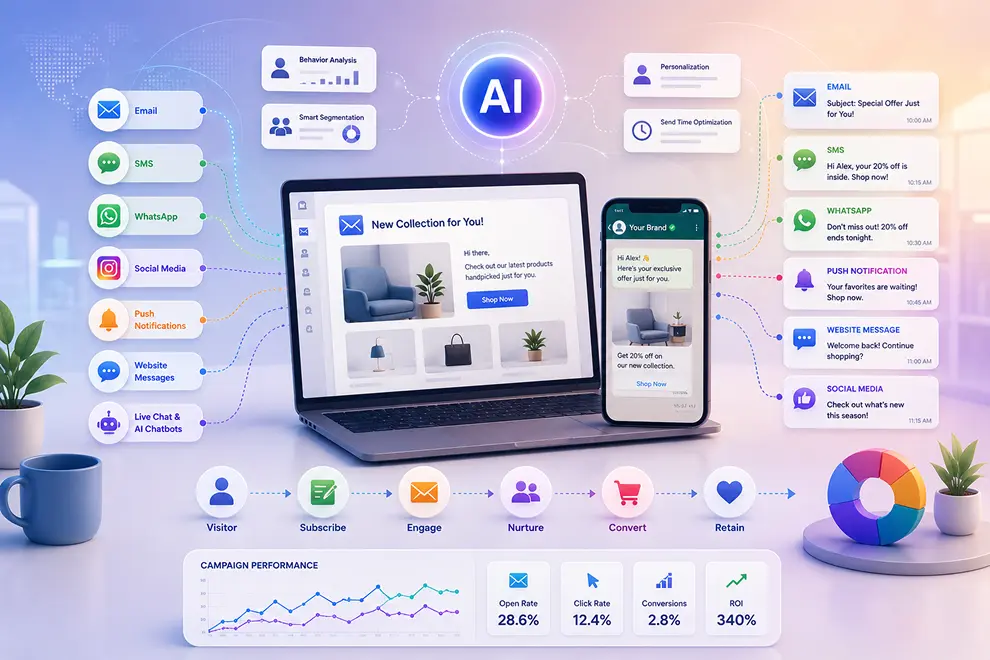
Email and multichannel marketing help businesses communicate with leads and customers across different stages of the customer journey. Email supports direct and personalized communication, while multichannel marketing extends engagement across SMS, WhatsApp, social media, push notifications, and website messages.
An AI-powered marketing platform connects these channels, analyzes customer behavior, and helps teams deliver relevant messages through the most suitable channel.
Email marketing involves sending newsletters, offers, product updates, educational content, and automated messages to subscribers and customers.
Multichannel marketing uses two or more channels to communicate with the same audience. For example, a business may introduce a campaign through email, send an appointment reminder through SMS, answer questions on WhatsApp, and re-engage website visitors through push notifications.
The objective is not to repeat the same message everywhere. Each channel should serve a specific purpose while contributing to one connected customer experience.
Successful campaigns begin with a permission-based contact database. Businesses should clearly explain what people are subscribing to and provide an easy way to manage preferences or unsubscribe.
Audiences can be segmented by:
AI can identify behavior patterns and automatically update segments as customer interests and engagement change.
Personalized emails use customer data to deliver relevant content instead of sending the same message to the entire database. Personalization can extend beyond adding the recipient’s name.
Businesses can personalize:
AI can help generate email copy, recommend subject lines, and adapt messages for different segments. Marketers should review AI-generated content to maintain accuracy, clarity, and brand consistency.
Each marketing channel has different strengths. Email is useful for detailed communication, SMS works well for short and time-sensitive messages, and WhatsApp supports direct conversations. Social media builds awareness and engagement, while website messages and push notifications encourage visitors to take immediate action.
Common marketing channels include:
CRM integration keeps interactions from these channels connected to the same customer profile, giving teams a complete communication history.
Marketing automation allows businesses to build journeys that respond to customer actions. Messages can be triggered when someone subscribes, submits a form, downloads a resource, abandons a process, makes a purchase, or becomes inactive.
For example, after someone registers for a webinar, the platform can:
AI can recommend the next message, channel, or delivery time based on the customer’s previous behavior.
Connected reporting helps marketers understand how individual channels and complete customer journeys perform.
Important metrics include:
AI-powered analytics can compare channel performance, identify engagement patterns, and recommend where marketers should adjust content, timing, audiences, or budgets.
Multichannel marketing should make communication more convenient, not overwhelming. Businesses should coordinate campaign schedules and apply frequency limits so customers do not receive too many messages across different channels.
Every campaign should use consistent brand messaging while respecting the style and purpose of each channel. Customer consent, communication preferences, and unsubscribe requests must also be maintained across the connected system.
AI can help identify declining engagement or message fatigue, but marketing teams should regularly review campaign journeys to ensure communication remains useful, timely, and human.
Integrate the tools you use every day and keep your sales data connected in one platform.





Discover how GoFox helps your sales team manage leads, automate follow-ups, and close deals with confidence, all from one intelligent CRM.
Get Started FreeReal feedback from teams who switched to a simpler way of managing customers and projects.
"This CRM completely transformed how our sales team manages customers. Within three months, we increased productivity by 35% and improved team communication significantly."
"Our team finally stopped juggling countless spreadsheets and switched to a cleaner, more efficient workflow solution."
"We moved away from messy manual processes and embraced a smoother workflow that keeps our whole team aligned."
"In just one day, our whole team was seamlessly collaborating and managing projects through a single dashboard."
CRM CRD is a modern CRM platform designed to simplify customer management. It streamlines daily tasks, organizes interactions, automates follow-ups, and helps teams collaborate more efficiently.
"Within just 60 seconds, our complete CRM system was set up and ready for immediate use."
"Our customer response time has improved by 40%, helping us provide faster and more efficient support."