

Take you business next level

Take you business next level
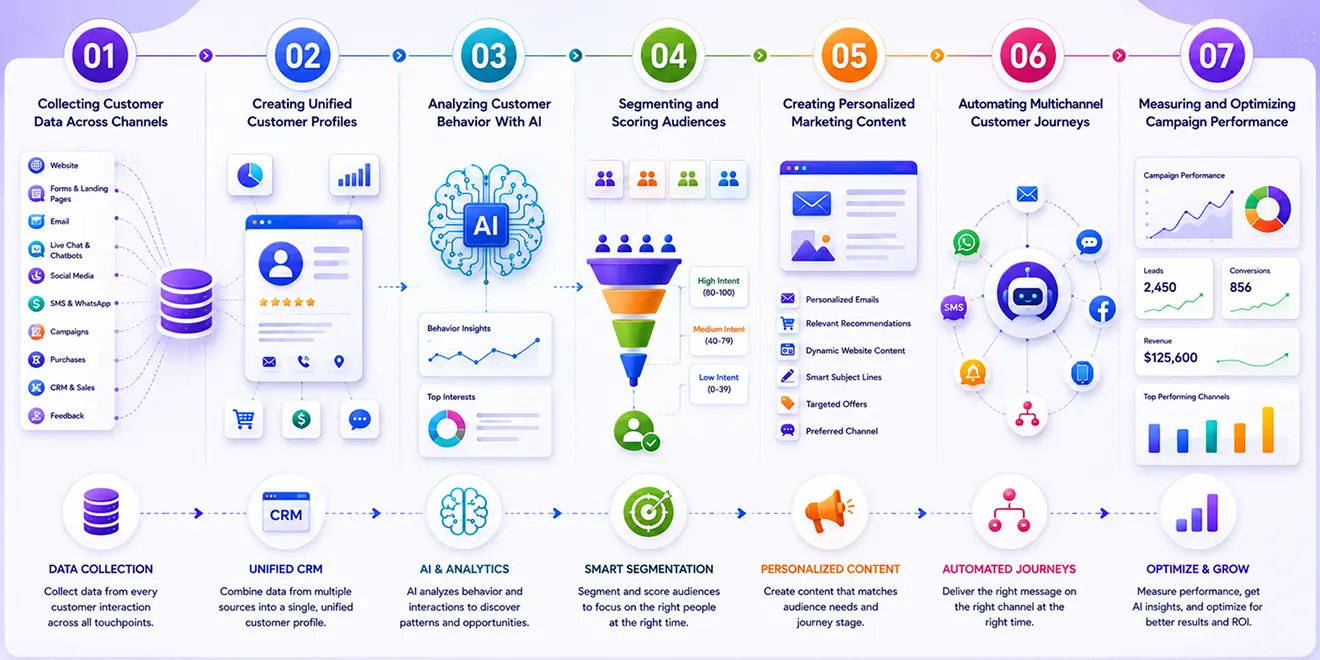
AI-Powered Marketing works by collecting customer data, analyzing behavior, and using those insights to personalize and automate marketing activities. It helps businesses understand what customers need, determine when to communicate, and select the most relevant channel and message.
The process connects customer data, artificial intelligence, CRM, automation, and marketing channels to improve every stage of the customer journey.
AI-Powered Marketing begins with customer data. Every interaction provides information about a person’s interests, preferences, engagement, and position in the buying journey.
Customer data can be collected from:
Businesses should collect and use this information responsibly, with appropriate customer consent and data protection controls.
After data is collected, the CRM connects information from different sources and organizes it into individual customer profiles. These profiles may contain contact information, communication history, website behavior, marketing engagement, sales activities, purchases, and service requests.
A unified profile prevents marketing information from remaining scattered across separate applications. AI can summarize customer histories and highlight recent or important activities, helping marketers quickly understand each person’s relationship with the business.
AI examines customer interactions to identify patterns that may be difficult to detect manually. It can analyze which content people view, which messages they respond to, how frequently they engage, and which actions indicate buying interest.
AI-powered analysis can help marketers understand:
These insights allow marketers to make decisions based on customer behavior instead of assumptions.
AI-powered marketing divides contacts into relevant audience groups using demographic, behavioral, and engagement data. These segments can change automatically as customers take new actions.
For example, audiences may be grouped by:
AI-powered lead scoring assigns value to each lead based on profile information and behavior. Highly engaged leads can be passed to sales, while early-stage leads can continue receiving educational content.
Once audiences are understood, AI can help marketers create and personalize content for different customer groups. It can support email copy, subject lines, social posts, website messages, landing page content, and calls to action.
Personalization may include:
Marketing teams should review AI-generated content before publishing it to maintain accuracy, clarity, and brand consistency.
Marketing automation uses triggers, conditions, and actions to deliver communication based on customer behavior. AI helps make these workflows more relevant by recommending suitable content, timing, audiences, and next steps.
For example, when a visitor downloads a guide, the system can:
These journeys can continue across email, SMS, WhatsApp, social media, push notifications, and website messages. This creates a connected experience even when customers switch between channels.
AI-powered marketing platforms track campaign activity and turn it into reports, dashboards, and recommendations. Marketers can understand what is performing well and where improvements are required.
Teams can measure:
AI can identify performance patterns, compare audience responses, and recommend adjustments to content, timing, segments, or channels. Marketers can use these insights to continuously improve campaigns and direct their budgets toward activities that deliver stronger results.
Integrate the tools you use every day and keep your sales data connected in one platform.






Discover how GoFox helps your sales team manage leads, automate follow-ups, and close deals with confidence, all from one intelligent CRM.
Get Started FreeReal feedback from teams who switched to a simpler way of managing customers and projects.
"This CRM completely transformed how our sales team manages customers. Within three months, we increased productivity by 35% and improved team communication significantly."
"Our team finally stopped juggling countless spreadsheets and switched to a cleaner, more efficient workflow solution."
"We moved away from messy manual processes and embraced a smoother workflow that keeps our whole team aligned."
"In just one day, our whole team was seamlessly collaborating and managing projects through a single dashboard."
CRM CRD is a modern CRM platform designed to simplify customer management. It streamlines daily tasks, organizes interactions, automates follow-ups, and helps teams collaborate more efficiently.
"Within just 60 seconds, our complete CRM system was set up and ready for immediate use."
"Our customer response time has improved by 40%, helping us provide faster and more efficient support."