

Take you business next level

Take you business next level
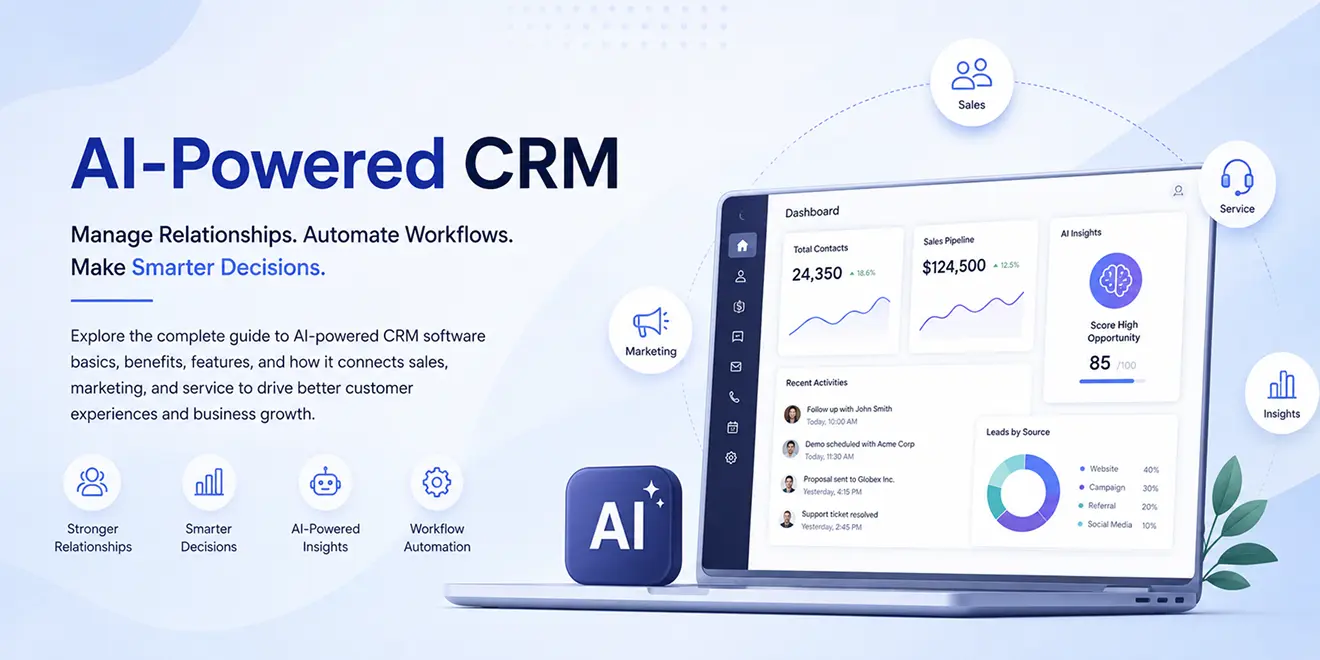
AI-powered CRM software helps businesses manage customer relationships, organize data, automate daily activities, and make smarter decisions from one centralized platform. It brings sales, marketing, and service interactions together while using artificial intelligence to identify patterns, recommend actions, and improve productivity.
Unlike traditional CRM systems that mainly store customer information, an AI-powered CRM actively helps teams use that information. It can prioritize leads, summarize conversations, personalize messages, automate follow-ups, and reveal insights that may otherwise be missed.
CRM stands for Customer Relationship Management. It includes the strategies, processes, and technologies businesses use to manage relationships with leads, prospects, and existing customers.
CRM software stores customer information and keeps a record of calls, emails, meetings, purchases, deals, campaigns, and service requests. This gives teams a complete view of every customer relationship.
Modern CRM platforms use AI to make this information more useful. Instead of requiring teams to review every record manually, AI can highlight important activities, recommend the next step, and help employees respond more effectively.
An AI-powered CRM can help businesses:
Before CRM software, businesses depended on notebooks, paper records, spreadsheets, emails, and separate databases. Customer information was often stored in different places, making it difficult for teams to find accurate details when they needed them.
Traditional CRM systems improved this process by bringing information into one database. However, employees still had to enter data, review records, update activities, and identify opportunities manually.
AI-powered CRM represents the next stage of customer management. It not only centralizes information but also helps teams understand the data, reduce manual work, and determine which actions require attention.
When customer data is scattered across different systems, teams cannot see the complete customer journey. Marketing may know which campaign attracted a lead, but sales may not have access to that information. Similarly, service teams may not know what a customer purchased or discussed with sales.
Disconnected data can lead to:
An AI-powered CRM connects this information and analyzes customer activities to uncover useful patterns. This helps teams focus on important conversations and opportunities without searching through multiple systems.
CRM software began as a digital system for storing names, phone numbers, addresses, and basic customer details. Over time, it expanded to include sales pipelines, marketing campaigns, service management, automation, reporting, and integrations.
Cloud-based CRM made customer data accessible to teams from different locations and devices. Businesses could collaborate without maintaining complicated software on their own servers.
The introduction of AI has transformed CRM from a system that simply records information into a platform that supports decision-making. Modern CRM software can analyze customer behavior, predict possible outcomes, automate routine activities, and recommend appropriate actions.
AI-powered CRM software collects customer data from different channels, organizes it into unified profiles, and analyzes activities to help teams understand what should happen next.
The process generally includes:
CRM software creates a complete history of the relationship between a customer and the business. It can store and manage:
AI helps teams make sense of this information. It can summarize lengthy conversations, identify changes in customer engagement, and surface the most relevant details before an employee contacts the customer.
An all-in-one CRM gives sales, marketing, and service teams access to the same customer information. Every team can understand previous conversations and continue the customer journey without asking customers to repeat themselves.
AI can help sales teams prioritize leads, identify promising opportunities, automate follow-ups, and recommend the next action for each deal.
Marketing teams can use CRM data to build customer segments, personalize communication, automate campaigns, and understand which activities generate valuable leads.
Service teams can review customer histories, summarize issues, automate ticket routing, suggest responses, and provide faster assistance.
By connecting these teams, CRM software creates a consistent experience from the first marketing interaction to the sale and continued service.
AI helps businesses move from reactive customer management to more proactive engagement. It can analyze large amounts of customer information faster than manual review and bring important insights directly to employees.
AI-powered CRM capabilities may include:
AI does not replace human relationships. It supports teams by reducing repetitive work and giving employees more time and context to communicate meaningfully with customers.
The future of CRM will be shaped by intelligent automation, connected customer data, and more personalized experiences. CRM platforms will increasingly help businesses understand customer needs before problems arise or opportunities are missed.
AI will continue to improve how businesses manage conversations, predict outcomes, recommend actions, and automate complex workflows. CRM software will become more than a customer database; it will act as an intelligent platform that helps teams make informed decisions throughout the customer lifecycle.
Integrate the tools you use every day and keep your sales data connected in one platform.






Discover how GoFox helps your sales team manage leads, automate follow-ups, and close deals with confidence, all from one intelligent CRM.
Get Started FreeReal feedback from teams who switched to a simpler way of managing customers and projects.
"This CRM completely transformed how our sales team manages customers. Within three months, we increased productivity by 35% and improved team communication significantly."
"Our team finally stopped juggling countless spreadsheets and switched to a cleaner, more efficient workflow solution."
"We moved away from messy manual processes and embraced a smoother workflow that keeps our whole team aligned."
"In just one day, our whole team was seamlessly collaborating and managing projects through a single dashboard."
CRM CRD is a modern CRM platform designed to simplify customer management. It streamlines daily tasks, organizes interactions, automates follow-ups, and helps teams collaborate more efficiently.
"Within just 60 seconds, our complete CRM system was set up and ready for immediate use."
"Our customer response time has improved by 40%, helping us provide faster and more efficient support."