

Take you business next level

Take you business next level
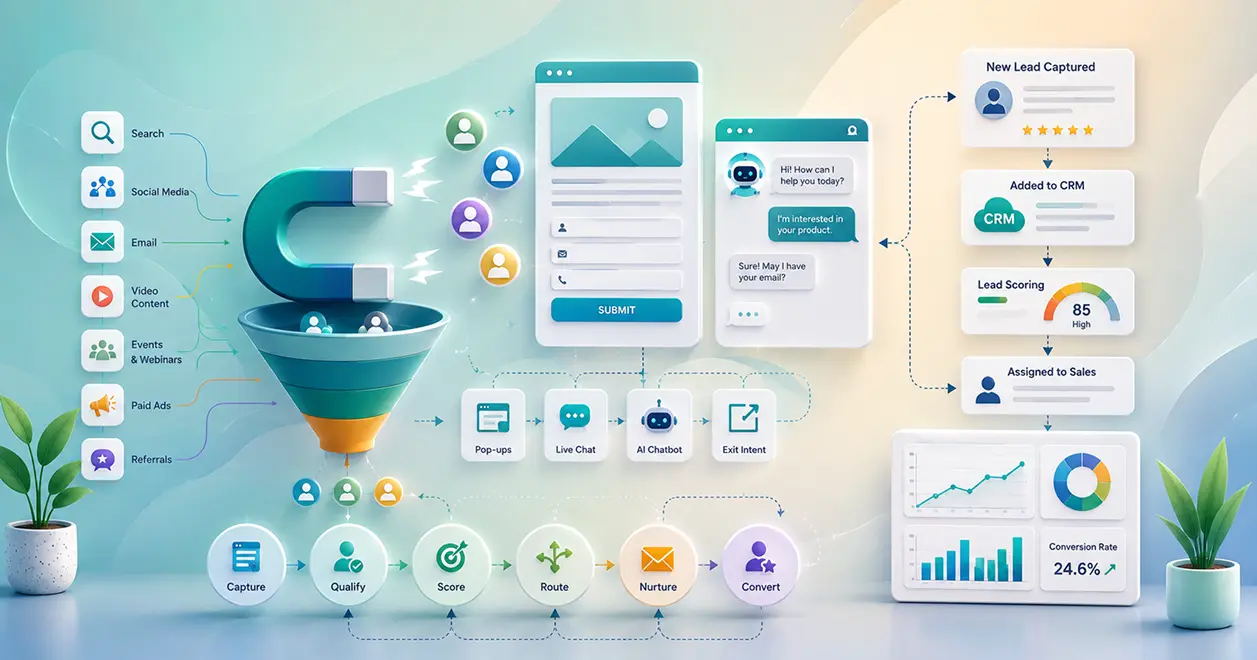
Lead generation and lead capture help businesses attract potential customers and collect the information required to continue the relationship. Lead generation creates awareness and interest, while lead capture turns that interest into identifiable contact information.
AI-powered marketing connects these activities by identifying promising audiences, personalizing engagement, capturing customer data, and automatically adding leads to CRM.
Although the terms are related, they represent different stages of the marketing process.
Lead generation involves attracting people who may be interested in a product or service. Businesses can generate interest through search engines, social media, educational content, emails, events, referrals, and paid advertising.
Lead capture happens when an interested visitor provides information such as a name, email address, phone number, company, or specific requirement. This usually occurs through a form, landing page, chatbot, live chat, or another conversion point.
Both processes must work together. Generating website traffic without effective capture methods may not produce leads, while capture forms provide limited value if the business is not attracting the right audience.
Successful lead generation begins with understanding the audience you want to reach. Marketing teams should define their ideal customer profile using industry, location, company size, job role, interests, pain points, and buying behavior.
Businesses can attract relevant audiences through:
AI can analyze existing customer data to identify common characteristics and help marketers focus campaigns on audiences that are more likely to engage.
Landing pages are focused web pages designed to encourage visitors to complete one specific action, such as requesting a demonstration, downloading a guide, registering for an event, or starting a free trial.
A lead-capture landing page should include:
AI forms can adapt fields or questions based on visitor information and previous activity. Keeping forms relevant and requesting only necessary information can make the capture experience easier.
Not every visitor is ready to complete a standard form. Website engagement tools give businesses additional ways to start conversations and capture interest.
These tools may include:
An AI chatbot can answer common questions, understand visitor requirements, collect contact information, and direct qualified enquiries to the appropriate team. Human assistance should remain available when visitors need detailed or sensitive support.
Potential customers interact with businesses through different channels. A multichannel strategy helps marketers reach audiences where they already spend time and connect those interactions to CRM.
Leads can be generated through email, websites, SMS, WhatsApp, social media, search engines, online events, video content, and paid advertising. Each campaign should use consistent messaging while adapting the content and format to the channel.
CRM tracking helps marketers understand which source generated each lead and which channels contributed to later engagement or conversion.
Capturing a lead does not always mean the person is ready to speak with sales. AI-powered lead qualification analyzes profile information, interests, website activity, campaign engagement, and buying signals to estimate lead quality.
The system can then:
This process allows sales representatives to focus on valuable opportunities while marketing continues engaging leads that require more time.
Tracking results helps marketers understand whether campaigns are attracting the right people and converting them effectively.
Important lead-generation metrics include:
AI-powered analytics can compare channels, audience groups, and campaigns to identify patterns. Marketers can use these insights to improve targeting, offers, landing pages, forms, and advertising budgets.
Integrate the tools you use every day and keep your sales data connected in one platform.






Discover how GoFox helps your sales team manage leads, automate follow-ups, and close deals with confidence, all from one intelligent CRM.
Get Started FreeReal feedback from teams who switched to a simpler way of managing customers and projects.
"This CRM completely transformed how our sales team manages customers. Within three months, we increased productivity by 35% and improved team communication significantly."
"Our team finally stopped juggling countless spreadsheets and switched to a cleaner, more efficient workflow solution."
"We moved away from messy manual processes and embraced a smoother workflow that keeps our whole team aligned."
"In just one day, our whole team was seamlessly collaborating and managing projects through a single dashboard."
CRM CRD is a modern CRM platform designed to simplify customer management. It streamlines daily tasks, organizes interactions, automates follow-ups, and helps teams collaborate more efficiently.
"Within just 60 seconds, our complete CRM system was set up and ready for immediate use."
"Our customer response time has improved by 40%, helping us provide faster and more efficient support."