

Take you business next level

Take you business next level
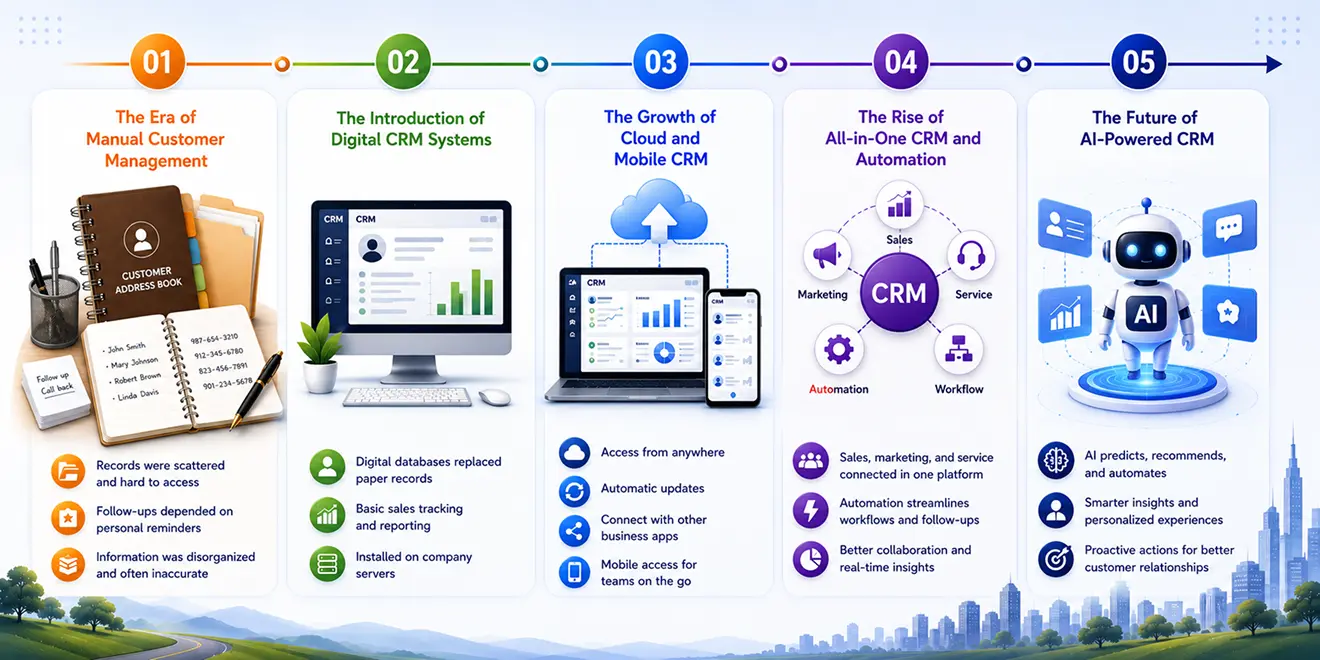
Customer Relationship Management has evolved from handwritten customer records into intelligent platforms that connect sales, marketing, and service. Each stage of CRM development has made customer information easier to organize, access, and use.
Today, AI-powered CRM software not only records customer interactions but also analyzes data, automates workflows, predicts outcomes, and recommends actions.
Before CRM software, businesses stored customer information in notebooks, paper files, address books, and physical filing systems. Sales representatives maintained their own customer records, while marketing and service teams managed information separately.
As businesses grew, manual customer management created several challenges:
These challenges created the need for a more organized and centralized way to manage customer relationships.
The first digital CRM systems replaced physical records with electronic customer databases. Businesses could store contact details, notes, sales activities, and account information on computers.
Early CRM software mainly supported sales teams and was often installed on company-owned servers. Although it improved data organization, implementation was expensive and required technical resources to maintain.
These systems introduced important capabilities such as contact management, sales tracking, activity scheduling, and basic reporting. However, access was usually limited to specific computers or company locations.
Cloud technology made CRM software more accessible to businesses of different sizes. Instead of installing and maintaining CRM systems on internal servers, companies could access them online through subscription-based plans.
Cloud CRM allowed teams to:
Mobile CRM further allowed employees to review records, update deals, schedule activities, and communicate with customers while working outside the office.
CRM expanded beyond basic contact and sales management. Modern all-in-one platforms began connecting sales, marketing, and service activities throughout the customer journey.
Sales teams could manage leads, pipelines, appointments, proposals, and forecasts. Marketing teams could build campaigns, create audience segments, and nurture leads. Service teams could manage tickets, live chat, SLAs, knowledge bases, and customer feedback.
Automation also allowed businesses to create workflows for lead assignment, campaign follow-ups, deal updates, appointment reminders, ticket routing, and service escalation. This development transformed CRM into a connected business platform rather than a tool used only by sales teams.
The future of CRM will focus on intelligent automation, predictive insights, and highly personalized customer experiences. AI will help businesses understand large volumes of customer data and take action before opportunities or problems are missed.
Future CRM capabilities will increasingly include:
AI will not replace human customer relationships. It will help employees work with better information, reduce repetitive activities, and focus on conversations that require judgment, creativity, and empathy.
AI-powered all-in-one CRM platforms such as GoFox represent this next stage by bringing customer data, connected teams, automation, and intelligent insights together in one system.
Integrate the tools you use every day and keep your sales data connected in one platform.






Discover how GoFox helps your sales team manage leads, automate follow-ups, and close deals with confidence, all from one intelligent CRM.
Get Started FreeReal feedback from teams who switched to a simpler way of managing customers and projects.
"This CRM completely transformed how our sales team manages customers. Within three months, we increased productivity by 35% and improved team communication significantly."
"Our team finally stopped juggling countless spreadsheets and switched to a cleaner, more efficient workflow solution."
"We moved away from messy manual processes and embraced a smoother workflow that keeps our whole team aligned."
"In just one day, our whole team was seamlessly collaborating and managing projects through a single dashboard."
CRM CRD is a modern CRM platform designed to simplify customer management. It streamlines daily tasks, organizes interactions, automates follow-ups, and helps teams collaborate more efficiently.
"Within just 60 seconds, our complete CRM system was set up and ready for immediate use."
"Our customer response time has improved by 40%, helping us provide faster and more efficient support."